

Silicone Nipple Covers: Material, Adhesion, Fit, and How to Choose the Right Style
Silicone Nipple Covers: Material, Adhesion, Fit, and How to Choose the Right Style
The best silicone nipple covers share four qualities: medical-grade platinum-cured silicone, a water-based gel adhesive, a tapered edge thin enough to disappear under fabric, and a matte finish that won't reflect through sheer fabric or show up in flash photography. Every pair that falls short of those four points involves a trade-off - and knowing which trade-off matters for your specific outfit and situation is what this guide is for.
We manufacture silicone body accessories at scale. That means we see, from inside a production facility, what separates a nipple cover that performs from one that ends up in the trash after the first wear. What follows covers the material science, the adhesive chemistry, the fit logic, and the application technique - in enough detail to make a confident decision rather than guess.
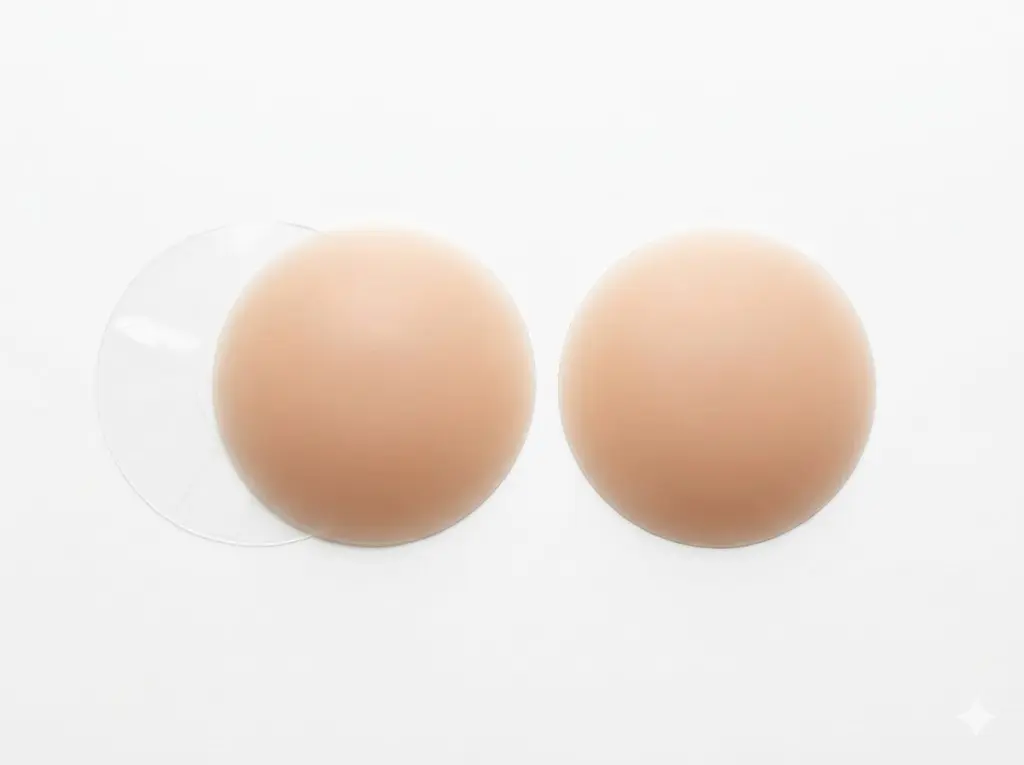
Medical-Grade Silicone vs. Standard Silicone: What Actually Differs
Not all silicone is the same material. The label "silicone nipple cover" gets applied to products made from widely different compounds, and the quality gap between them is significant enough to matter in practice.
Medical-grade, platinum-cured silicone is the benchmark. It belongs to the same class of material used in wound dressings and surgical-contact devices - biocompatible, latex-free, BPA-free, and thermally stable under body heat for extended wear periods. The platinum curing process is important because it leaves no harmful residue in the finished silicone. Peroxide-cured alternatives, which cost less to produce, can release trace byproducts during the curing process that irritate sensitive skin over time. ISO 10993, the international standard for evaluating the biocompatibility of materials used in skin-contact applications, provides the testing framework that distinguishes material classes in this category - covering cytotoxicity, sensitization, and irritation under protocols like ISO 10993-5 and ISO 10993-10.
Lower-grade silicone is stiffer, slightly shinier, and less flexible. In practice, that means it doesn't conform to the natural curve of the breast - it sits on top of it, which creates a visible raised ring under any fitted clothing. It also degrades faster with washing. The adhesive surface of a cheap pair tends to fail within three to five uses because the base material can't hold a stable adhesive layer. If you've bought a low-cost pack online and found it useless within a week, that's the explanation.
Our silicone nipple covers are produced using compression molding with platinum-cured silicone that has been evaluated for skin contact. The edge taper in the final product is thin enough to read as a transition rather than a boundary under fabric - which is the difference between a cover that's invisible and one that leaves a shadow line.
What Makes a Nipple Cover Actually Work: Five Factors That Matter
Edge taper. This is the single most important construction variable. The thinnest possible taper at the perimeter is what makes a cover invisible under clothing. A blunt or thick edge will always create an outline under fitted or sheer fabric - there's no application technique that compensates for a poorly tapered edge.
Adhesive type. Water-based gel adhesive is gentler on skin, easier to clean, and restores its grip after washing and air-drying correctly. Solvent-based adhesives bond more aggressively on first application but are harder on skin over repeated use and don't recover as well after washing. For daily-wear use, water-based is the right choice.
Finish. Matte silicone does not reflect light. Glossy silicone does - which means it can show through thin fabric and appear in flash photography as a distinctly bright patch. For sheer tops, backless dresses, or anything camera-adjacent, matte is non-negotiable.
Coverage diameter relative to areola size. The cover must extend slightly beyond the full areola on every side to lie flat against skin rather than trying to adhere at the areola's edge. When a cover is too small for a given areola, the inner perimeter of the adhesive lifts - no amount of pressing will hold it down. More on sizing below.
Skin tone match. Under white, cream, or light-colored fabric, a cover that doesn't approximate your skin tone will be visible even with a perfect edge taper. This is a factor that deserves more than a line in a spec sheet, which is why we cover it in its own section below.
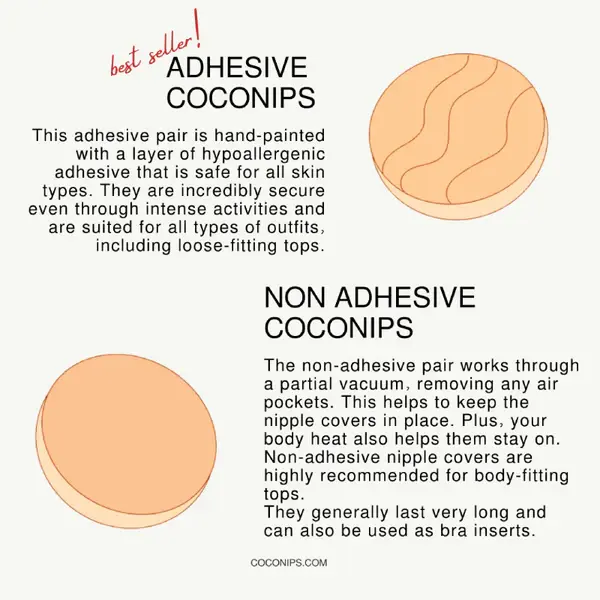
Adhesive Covers vs. Non-Adhesive: Which One You Actually Need
Adhesive nipple covers - the type with a self-stick backing that bonds directly to bare skin - are the right tool for backless dresses, plunging necklines, swimwear, and any outfit where the fabric provides no structure to hold anything in place. They work independently of what you're wearing. The limitation is real: they require completely clean, dry, oil-free skin to perform correctly. Moisturizer applied before getting dressed is the single most common reason covers slip during the day - not product failure.
Non-adhesive covers rely on friction and light compression from fitted clothing to stay in position. They're genuinely better for people with adhesive sensitivity, and they work well under tight sports bras, structured bodices, or compression layers. They are not a substitute for adhesive covers in anything loose, sheer, or backless. Some brands describe this as "grippy, not sticky" - which is accurate, but has real limits that don't always make it into the marketing copy.
For a detailed look at why adhesive performance varies between products and what actually degrades stickiness fastest, this breakdown of how silicone nipple cover adhesion works covers the chemistry behind it.
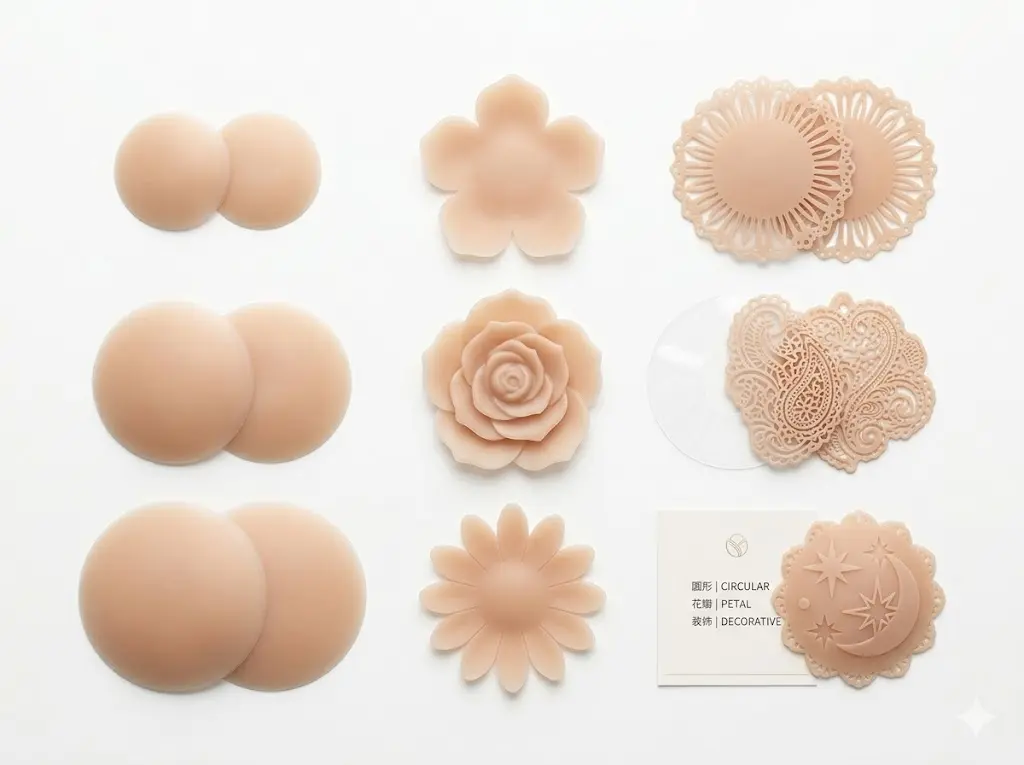
Choosing the Right Shape: Round, Petal, and Decorative Styles
Round covers are the default for good reason. They work for the widest range of necklines, apply without alignment concerns, and provide even coverage in all directions. The center is the thickest point for full opacity; the edge tapers toward the perimeter. For most everyday use cases - a fitted top, a backless blouse, a swimsuit - a well-made round cover is the correct answer.
Petal and flower shapes exist for two distinct use cases that people often conflate. The first is specialty necklines: deep V-cuts, asymmetric cuts, or one-shoulder styles where a standard round cover would be visible at the neckline edge. In those cases, the shape of the cover is trimmed to fit the geometry of the opening. The second use case is intentional visibility - sheer fabric where some of the cover is meant to read as a design element rather than pure concealment. Decorative and petal-style nipple covers are designed to work in both modes, which changes the design requirements: the edge treatment and finish matter differently when the product might be seen.
Heart and novelty shapes serve a fashion function, not a concealment one. They're used in festival wear, lingerie styling, and sheer outerwear where the cover is intentionally part of the visible look. If the goal is invisibility, these aren't the right category - if the goal is aesthetic, they work well for the purpose.
A simple decision framework: if you need the cover to disappear entirely, choose a round matte cover in your skin tone. If the neckline geometry makes a round cover problematic, choose a petal or shaped style that fits the cut. If the cover being partially visible is acceptable or desired, decorative styles give you more options.
Getting the Size Right
Most standard nipple covers in the US market run approximately 3.5 to 4 inches in diameter, based on what we see across the range of products manufactured in this category. That size works for the majority of people but isn't universal - and sizing down creates specific, predictable problems.
The rule is straightforward: the cover must extend fully beyond the areola on all sides. Measure your areola diameter and add at least half an inch to determine the minimum cover size you should use. If you're between sizes, go larger - a slightly oversized cover tucks away invisibly far more reliably than one that's even slightly too small.
When covers peel at the inner edge specifically (rather than at the outer perimeter), undersizing is almost always the cause. The adhesive is trying to bond at the edge of the areola rather than against flat skin, and that bond won't hold through movement or body heat regardless of adhesive quality.
Manufacturers who offer multiple diameter options have actually thought through this problem. Single-size products are a production convenience, not a sizing solution.
Skin Tone Matching: More Than a Color Preference
Under opaque fabric, skin tone match is irrelevant - the cover is hidden regardless. Under white, cream, champagne, nude, or any light-colored fabric, a cover that reads visibly different from your skin will show through even with a perfect edge taper. Under sheer fabric, the difference becomes even more pronounced.
This matters most for lighter fabric colors because the contrast between the cover and surrounding skin is more visible. For darker skin tones, the gap between available cover shades and actual skin tones has historically been the real problem - many products are produced in "nude" shades calibrated to a narrow range of lighter skin tones, which means people with medium to deep skin tones are often buying covers that are noticeably lighter than their skin.
When evaluating options, look at the shade range actually offered, not just whether a "nude" option exists. For sheer fabric specifically, even a close-but-not-matching shade will be visible - prioritize the closest available match over other factors if you're wearing anything truly sheer.
Nipple Covers for Specific Situations
Backless dresses and formal wear. Adhesive silicone covers are the correct tool here - they work without any garment structure to hold them. Apply to completely dry skin at least ten minutes before putting on the dress. For formal events with extended wear (weddings, galas), do a test wear a few days before to confirm adhesion holds through your body temperature and movement patterns. Our medical-grade covers are designed for exactly this kind of extended single-day wear.
Swimming and intense exercise. Medical-grade silicone with a water-based gel adhesive is waterproof and sweat-resistant - the material itself is not the limiting factor. Adhesion is. Apply to fully dry skin and allow at least ten minutes of bonding time before water exposure. Covers applied to damp skin will fail in water regardless of how good the adhesive is. For high-impact exercise, smooth the entire edge firmly after application and press from center outward to eliminate any air pockets.
High-heat environments. Body heat alone doesn't compromise a quality adhesive, but heat combined with heavy sweating can. If you know you'll be in a very hot environment - an outdoor summer event, a heated venue - clean skin preparation matters even more than usual. No dry shampoo spray near the chest area, no body mist, nothing that leaves a film.
Sensitive skin. Platinum-cured medical-grade silicone is among the most inert materials used in skin-contact applications. True allergic reactions to platinum-cured silicone are rare - most reported skin reactions are caused by additives or impurities in lower-grade products, or by overly aggressive removal technique rather than the material itself. If you've had reactions to silicone products before, check whether those products specified platinum-cured medical-grade silicone or simply "silicone." The distinction is significant. If you're uncertain, do a 24-hour patch test on a small skin area before full use.
How to Apply Them So They Stay On
Application technique is responsible for the majority of wear failures. The product usually works - the preparation doesn't.
Start with skin that's been washed with mild soap, rinsed, and given time to fully air-dry. Towel-dry isn't sufficient on its own - give it a full minute of air time after toweling. Any moisture sitting under the adhesive creates a micro-barrier that degrades hold progressively over the following hours. No moisturizer, no body oil, no dry shampoo spray that drifted. If you applied lotion earlier, wipe the area with a clean damp cloth and let it dry completely before applying the cover.
Peel the backing slowly - pulling quickly can distort the thin silicone edge out of shape. Position the cover centered over the nipple first, press from the center down, then smooth firmly outward toward the perimeter with your fingertips. This step removes trapped air pockets, which are what cause edges to peel up during wear. Hold firm pressure at the center for about ten seconds.
For removal, take your time. Pull from the outer edge inward, using your other hand to keep the surrounding skin gently taut. Fast removal is what causes the redness and soreness that often gets blamed on the product - slow, consistent tension is essentially painless. If resistance is high, warm water helps the adhesive release without skin stress.
Silicone Nipple Covers vs. Silicone Bras: Which One Fits Your Outfit
There's consistent confusion between these two products, partly because some brands use the terms interchangeably and partly because they overlap in use case at the edges.
A nipple cover covers the nipple and areola only. It provides no lift, no lateral support, and no shaping - its function is concealment and modesty. For a backless look where you want zero visible garment, minimal coverage footprint, and no structure showing at any angle, a well-made nipple cover is often the better tool precisely because of what it doesn't add.
A silicone bra covers significantly more breast area, offers varying degrees of lift through wing construction or push-up design, and provides some shaping alongside coverage. It's more substantial to apply and more noticeable at neckline and side edges if the fit isn't exact - which matters in very low or very open necklines where a nipple cover would simply disappear.
For smaller bust sizes in fitted or structured clothing, nipple covers are often a complete functional substitute for a bra in terms of modesty. For larger bust sizes, or for any outfit where lift and shaping matter alongside coverage, a silicone bra or the combination of breast tape and nipple covers is the more honest answer. Nipple covers alone don't provide support - that's not a limitation of any specific product, it's the category.
Both products in our line are produced from the same medical-grade silicone and built to the same manufacturing standards. You can explore the full silicone breast accessories range if you're working through fit options for a specific garment.

Care and Storage: What Actually Preserves the Adhesive
Wash after every single use - not occasionally, every wear. Body oils, sweat, and skin cell residue are what degrade the adhesive surface faster than anything else. Use your fingertips with a small amount of mild soap and warm water, working gently in circles on the adhesive side. Rinse thoroughly and completely.
Air dry only, adhesive-side up on a clean, flat surface. Towel drying leaves fiber debris embedded in the adhesive that progressively reduces stickiness over subsequent uses. Don't use a hairdryer - concentrated heat accelerates edge degradation in silicone, even medical-grade material. Fifteen to twenty minutes at room temperature is typically sufficient.
Replace the protective film over the adhesive before storing. The film isn't just packaging - it protects the adhesive from dust and lint accumulation, which is difficult to remove without damaging the surface. A small clean case or the original packaging works well. Keep away from direct sunlight and heat sources.
With proper care at each step, medical-grade covers from our production testing typically hold adhesion for 25 to 40 uses before the surface degrades enough to affect performance. Covers that lose stickiness after five or six uses have almost always failed due to residue buildup or incomplete drying - not material quality. The care routine is not optional maintenance; it's what determines whether you get 15 uses or 40 out of the same pair.
Frequently Asked Questions
Do silicone nipple covers work for swimming or intense workouts?
Yes, provided the application prep is correct. Medical-grade silicone with a water-based adhesive is waterproof and sweat-resistant. The adhesive needs completely dry skin to bond properly - covers applied to even slightly damp skin will fail in water, regardless of adhesive quality. For swimming, apply at least ten minutes before water contact to allow full bonding. For exercise, pay extra attention to eliminating any air pockets at the edges before your session.
Are silicone nipple covers safe for sensitive skin?
Platinum-cured medical-grade silicone is among the most inert materials used in skin-contact applications, and true allergic reactions to this material are uncommon. Most reported skin reactions are caused by either lower-grade silicone with processing residues, aggressive removal technique, or wearing covers for extended periods without giving skin a break. If a product simply says "silicone" without specifying platinum-cured medical-grade, the production standard may be significantly different. When in doubt, do a 24-to-48-hour patch test before full use.
How many times can a silicone nipple cover be reused?
Based on our internal durability testing under standard care conditions, medical-grade covers typically perform reliably for 25 to 40 uses. The adhesive surface is the limiting factor - it degrades with residue buildup faster than the silicone material itself wears out. Consistent washing after every use, correct air drying, and storage with the protective film in place are what determine where in that range your pair lands. Covers that fail within five or six uses are almost always failing due to inadequate care between wears.
What's the difference between decorative nipple covers and standard ones?
Standard covers are engineered to disappear - matte finish, skin-tone-matched, tapered edge, maximum invisibility under fabric. Decorative styles are designed with the possibility of visibility built in: shapes, textures, or colors that can function as part of a sheer-fabric look rather than purely as concealment. The adhesive construction and edge taper may be identical between the two; the aesthetic intent is different. If your goal is zero visibility, use a skin-tone matte cover. If the cover being partially visible is acceptable or part of the look, a decorative style works for either purpose.
Can nipple covers substitute for a bra for larger cup sizes?
For concealment only, yes. For support, no - nipple covers provide coverage and nothing else. There's no lift, shaping, or lateral support regardless of cup size or product quality. For smaller bust sizes in structured or fitted clothing, covers are often a complete functional substitute for a bra in terms of modesty. For larger bust sizes, or any outfit where support matters alongside coverage, the honest answer is silicone adhesive bras, breast tape, or a combination approach. Nipple covers alone won't provide structural support - that's a category limitation, not a brand one.
Why do my nipple covers keep peeling at the inner edge?
Undersizing is the most common cause. If the cover doesn't extend fully beyond the areola on all sides, the adhesive is trying to bond at the curved edge of the areola rather than against flat skin - and that bond won't hold through movement or body heat. Measure your areola diameter, add at least half an inch, and size up from there. If you're already using the correct size, check whether any moisturizer or body product residue is on the skin at the edge - even a small amount will prevent proper adhesion.


