


Wash your toy before and after every single use with warm water and unscented antibacterial soap, use water-based lubricant only, start slow, and store it completely dry in its own breathable bag. That covers the essentials. The rest of this guide explains the why behind each of those rules - including the ones most people discover by breaking them first.

What Is Medical-Grade Silicone - And Why It Matters for Body Safety
The word "silicone" on a product label tells you almost nothing without more context. A kitchen spatula, a surgical catheter, and a novelty toy from a discount shelf can all technically call themselves silicone. The differences in material quality between them are substantial.
What you want in a body-contact product is platinum-cured, medical-grade silicone. This is the same category of material used in surgical tools and long-term medical implants - materials evaluated against ISO 10993 biocompatibility standards recognized by the FDA for assessing biological safety in human-contact devices. The defining property is that it's non-porous: bacteria, bodily fluids, and pathogens cannot penetrate the surface. You can genuinely sterilize it, not just rinse it.
Compare that to jelly rubber, PVC, and TPE - all common in cheaper toys. These materials are porous, meaning bacteria settle into microscopic surface gaps that soap and water can't reach. Even TPE anal plugs, while softer and more affordable, require more diligent cleaning and condom use specifically because of this property.
Platinum-cured silicone also contains no phthalates and no plasticizers. It won't off-gas, degrade from body heat, or break down from repeated cleaning. The higher cost reflects a material that can be genuinely maintained over years of use.
Three quick checks when evaluating any toy: real platinum-cured silicone has essentially no odor out of the box; water beads off the surface rather than soaking in; and the finish is slightly matte or satin - not shiny, not sticky. If a toy smells of chemicals straight from the packaging, that matters.
Our silicone vibrators and silicone dildos are made from platinum-cured material for exactly this reason. When a manufacturer lists "medical-grade silicone" without specifying the cure method, it's worth asking for documentation directly - reputable manufacturers can provide certification records.
Before First Use: How to Inspect and Clean a New Toy
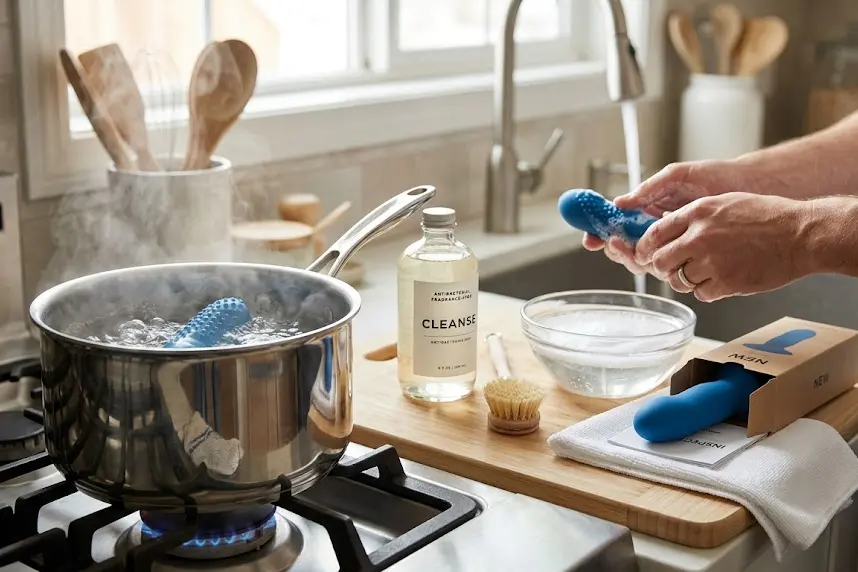
New doesn't mean sterile. Before that, a product passed through a manufacturing facility, a packaging station, a warehouse, a logistics hub, and your doorstep. Wash it before the first use regardless of what the box says.
For non-motorized silicone toys - dildos, plugs, solid vibrators with no internal electronics - the most thorough approach is a brief boil. Three to five minutes in a pot of boiling water is sufficient. Rest a small towel or silicone mat on the pot's bottom so the toy doesn't contact the metal directly, then let it cool completely on a clean surface before handling. That's your cleanest possible starting point.
For anything with electronics - vibrators, app-controlled toys, rechargeable devices - boiling is off the table. Wash by hand with warm water and fragrance-free antibacterial soap, working the lather into every seam, button crevice, and textured section. Rinse thoroughly, pat dry with a clean cloth, and let it finish air drying before use. There's a meaningful difference between "waterproof" and "splash-resistant" on product specs; if yours is only splash-resistant, keep water away from the charging port entirely.
Before that first use, take a minute to actually look at the surface. Consistent texture, no sticky patches, no chemical smell, no visible seam separation. If something feels wrong before you've even tried it, trust that instinct - quality control exists, but it's not infallible.
Water-Based Lubricant and Silicone Toys: Why Compatibility Matters
If there's one rule in this guide that saves the most toys, this is it: use water-based lubricant only with silicone toys.
Silicone-based lubricants are genuinely excellent in plenty of contexts - they last longer, don't dilute in water, and feel noticeably smooth. The problem is chemistry. Silicone-based lubricants can chemically interact with silicone toy surfaces: the lubricant's lower-molecular-weight silicone compounds migrate into and physically bond with the toy's surface over time, causing it to become tacky, swell slightly, or begin to degrade. This doesn't always happen visibly on the first or second use - which is exactly why people sometimes think they're in the clear. The surface compromise is cumulative.
Water-based lubricant is compatible with all silicone materials, leaves no residue, and washes off cleanly. The trade-off is that it requires reapplication during longer sessions and dilutes in water. That's manageable. Oil-based lubricants are also incompatible - they leave a coating that resists ordinary washing and accelerates surface breakdown over time.
For anal play specifically, use considerably more lubricant than feels intuitive. The tissue there doesn't self-lubricate, and adequate lubrication is the difference between comfortable use and micro-trauma to delicate tissue. Our silicone anal toys are designed with tapered, smooth profiles to help the body adjust gradually - but shape only does part of the work. Lube does the rest.
How to Use Each Type of Silicone Sex Toy
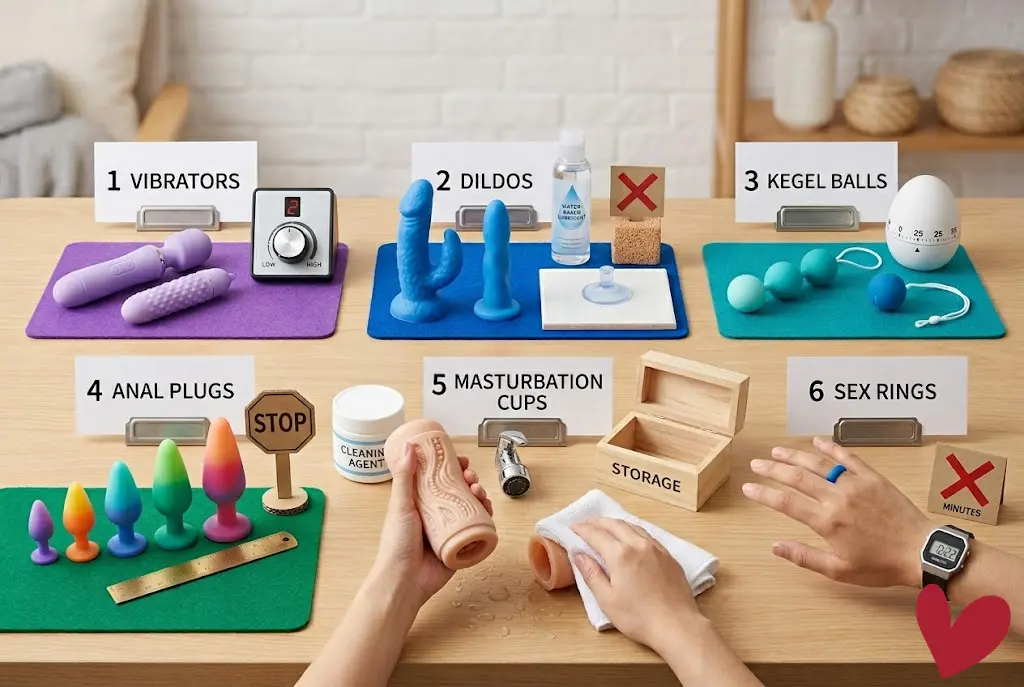
Most guides either gloss over this section or give the same vague advice for every product type. The reality is that vibrators, dildos, kegel balls, and anal plugs are physically different tools designed for different purposes - and using them well requires understanding what each one actually does.
Vibrators. The most common beginner mistake is starting too high. Vibration at maximum intensity before the body has adjusted to the sensation tends to produce numbness faster than pleasure. Start at the lowest setting and work up only when your body has responded and settled. For external clitoral vibrators, consistent, gentle pressure against the body is typically more effective than rapid movement - think hold and adjust, not rapid back-and-forth. For internal use, move slowly enough at each depth that your body can actually respond before going further. Rushing internal use doesn't enhance the experience; it mostly causes discomfort.
Dildos. Silicone has slightly more surface friction than skin, so water-based lubrication isn't just comfortable - it's what makes smooth movement possible. If you're using a suction-cup base, the mounting surface needs to be flat, non-porous, and clean for suction to hold. Glazed tile or glass work well; unfinished wood or textured walls don't. The one rule that applies without exception: never use a dildo for anal play unless it has a flared base wide enough to sit flat outside the body. The anatomy can generate genuine suction that pulls objects inward, and retrieving a toy without a base stop requires medical assistance - this happens more often than most people realize.
Kegel balls. These are pelvic floor training devices, not high-sensation toys - and that framing matters for how you use them effectively. Most pelvic health physical therapists recommend starting at fifteen to thirty minutes of wear per session, building duration gradually over weeks rather than immediately pushing for longer wear. The benefits - improved pelvic floor strength, better bladder control, increased sensation over time - are cumulative and won't be felt immediately. Remove them if you experience cramping, pressure, or pelvic discomfort. Kegel balls should always have a retrieval cord, and that cord is how you remove them - never strain or bear down forcefully. If you've had recent pelvic floor surgery or repair, get clearance from your provider first; there's a more specific discussion of kegel ball use after hysterectomy that may be relevant.
Anal plugs. Start with the smallest size available, and mean it. There is no timeline here and nothing to prove. A five-minute beginner session that ends comfortably is a fully successful session. Every toy used anally needs a flared base - a base that extends wide enough outside the body that it physically cannot be pulled in. This isn't optional or stylistic; it's a safety requirement. Generous lubrication, a slow pace, and stopping at any sharp or persistent pain are the constants. Dull pressure as the body adjusts is normal; sharp pain is not. Browse our full anal plug range for options by size and material, including beginner-appropriate silicone designs.
Masturbation cups. Male masturbators present a specific cleaning challenge because of their internal canal structure. After each use, invert the sleeve if it's removable and rinse the interior directly under warm running water. Non-invertible designs require flushing water through the canal repeatedly until runoff is clear. Shake out excess water, then dry with a lint-free cloth before air drying completely - moisture trapped inside a textured sleeve is where odor and bacterial buildup actually originates. Do not store until fully dry. Our masturbation cups include care instructions for each specific design; follow those over generic advice when they differ.
Sex rings. These are typically worn during partnered sex or solo use to maintain or enhance sensation. The key fit consideration: a ring that's too tight cuts off circulation, which causes discomfort and can become unsafe after extended wear. A correct fit is snug but not painful, and rings should not be worn for more than twenty to thirty minutes at a time. Silicone rings are flexible enough to stretch for removal, but if a ring becomes difficult to remove or causes persistent pain or numbness, remove it immediately. Browse sex ring options including adjustable designs that accommodate fit concerns.
Sex Toy Storage: How to Keep Silicone Toys Safe Between Uses
Silicone is non-porous, which means bacteria from the environment can't penetrate the material - but it can absorb odors, and improper storage causes physical damage that's difficult or impossible to reverse.
The specific problem with storing toys in contact with each other: silicone toys from different manufacturers may have slightly different formulations. Direct surface contact over extended periods can cause them to bond or become tacky - a reaction that worsens over time and can't be cleaned off. Store each toy individually in its own breathable pouch. Satin and cotton both work well. Avoid plastic zipper bags for anything beyond a few days, as they trap moisture instead of allowing it to dissipate.
Beyond that, the requirements are simple: a cool, dry location away from direct sunlight and heat sources. Ultraviolet exposure and heat accelerate silicone surface breakdown over time, even on high-quality material.
For battery-operated toys, remove batteries before long-term storage. Corroding batteries damage both the toy's internal contacts and whatever surface they're sitting on. For USB-rechargeable toys, storing at roughly 50–70% charge is better for lithium battery longevity than storing fully charged or fully depleted - both extremes accelerate capacity loss over time.
One thing that catches people off guard: moisture sealed inside a storage bag, even in small amounts, is how odor and surface discoloration develop on otherwise good silicone. When you're uncertain whether a toy is fully dry, give it another hour of open-air drying before bagging it.
For a broader look at products across our full range - including items that have specific storage requirements - see our sex toys for women and sex toys for men category pages, where product-specific care notes are listed with each item.
Signs It's Time to Replace Your Silicone Sex Toy
One question we get occasionally from users goes something like this: "I've had this toy for three years and the surface has started to feel slightly sticky no matter how I clean it - is it still safe?" The honest answer is no, and the reason matters.
A tacky or sticky surface that persists after washing is a sign of silicone material degradation. Once the surface starts to break down at a molecular level, it can no longer be fully sanitized - the compromised texture creates micro-environments where bacteria can persist. That changes what the toy is appropriate for, regardless of how much you liked it. Other replacement signals: visible cuts or tears in the surface (even small ones); a chemical or rubbery smell that wasn't present when the toy was new; or discoloration that doesn't resolve with thorough cleaning. These aren't cosmetic issues - they're hygiene indicators. Good quality silicone toys last years with proper care, but they don't last forever.
Frequently Asked Questions About Silicone Sex Toys
I accidentally used silicone-based lube on my silicone toy. Is it ruined?
Not necessarily, at least not immediately. Wash the toy thoroughly with warm water and unscented soap, then dry it completely and check the surface. If it still feels smooth and non-tacky, it may be fine - the interaction is cumulative rather than instant, so a single accidental use is less damaging than repeated exposure. Switch to water-based lubricant from this point and monitor the surface over the following weeks. If tackiness develops and doesn't wash off, that's the degradation signal.
How do I verify a toy is actually medical-grade silicone and not just labeled that way?
Three checks that don't require lab equipment. First, smell it: genuine platinum-cured silicone has essentially no odor out of the box - any chemical or rubbery smell is a signal. Second, water test: drip water on the surface; it should bead off cleanly, not absorb. Third, surface feel: medical-grade silicone is matte or satin in finish, slightly silky, and non-sticky - not shiny, not plastic-feeling, not tacky. For the most reliable confirmation, contact the manufacturer and ask for their material certifications. Any legitimate manufacturer working in this space should be able to provide ISO 10993 documentation or equivalent test results. If they can't produce documentation, that's useful information.
Is it safe to use a silicone sex toy during pregnancy?
According to the American College of Obstetricians and Gynecologists (ACOG), most sexual activity - including penetration with sex toys - is safe for people with healthy, uncomplicated pregnancies. The amniotic sac and uterine muscles provide substantial protection. However, certain conditions do require avoiding penetrative activity: placenta previa, signs of preterm labor, cervical insufficiency, or any situation where your provider has advised against sexual activity. If you have any of those risk factors, or if you're simply unsure, ask your ob-gyn directly - that conversation is always appropriate and worth having. Mayo Clinic's guidance on sex during pregnancy covers additional context on when to be cautious.
Can non-motorized silicone toys go in the dishwasher?
Yes - with two conditions. There must be absolutely no electronic components in the toy, and the dishwasher should run without pods or tablets (the chemicals in standard detergent pods are unnecessarily harsh and may leave residue). Top rack, hot cycle. A sanitize cycle, if your dishwasher has one, is more thorough because it uses higher sustained temperatures. This is actually a reliable sterilization method specifically because of that sustained heat exposure - more consistent than a quick hand wash.
What's the practical difference between a silicone vibrator and a silicone dildo?
Vibrators add motorized stimulation to their physical presence - most are used for targeted external clitoral stimulation or internal vibration, and intensity is adjustable. Dildos offer physical fullness and manual movement without vibration, which many people find more intuitive to control and easier to pace. Neither is superior; it comes down to what your body responds to and what kind of control you want over the experience. Many people use both for different purposes. Mini vibrators are worth considering if you're new to vibration - the smaller form factor makes precise placement easier and intensity more manageable than a full-size model.
Are there specific cleaning considerations for toys used in BDSM play?
Silicone remains the most cleanable material in any use context, including impact or restraint play. The main additional consideration is surface inspection: any use that could introduce abrasion, bite marks, or contact with sharp materials requires a closer visual check before the next use. Silicone tears more easily once a surface crack starts - watch for any break in surface integrity. Our BDSM product range includes items with specific material compositions; always follow the care instructions for each product rather than applying blanket silicone cleaning rules.


