


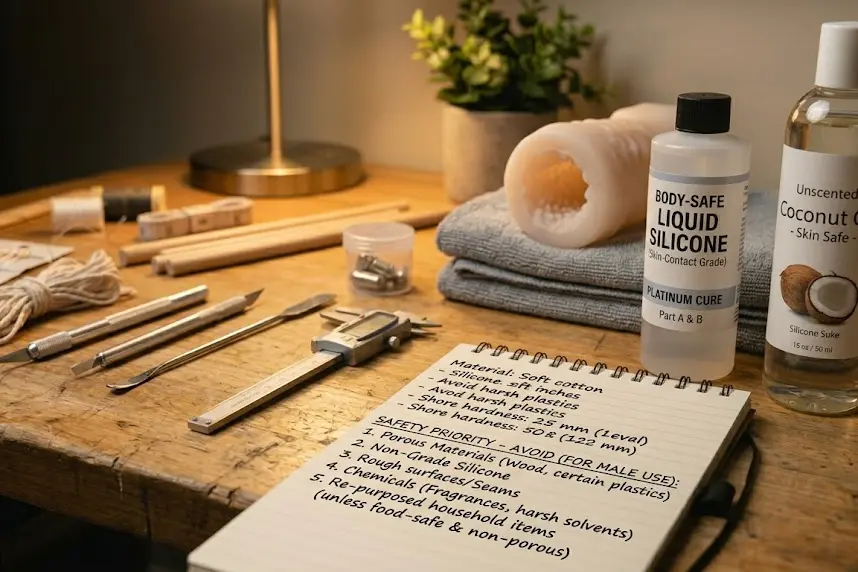
Can Homemade Sex Toys Actually Be Safe?
DIY sex toys for men are a real option, not a fringe one. What separates the approaches that work from the ones that cause injury has less to do with creativity and more to do with biology and materials science. Three failure modes appear repeatedly in sexual health literature:
Material toxicity. Soft plastics, scented lotions, coated metals, and many common household materials are not designed for sustained contact with sensitive skin. Genital tissue absorbs chemical irritants more readily than most other skin on the body. Hormone-disrupting compounds such as phthalates - found in many soft plastics and jelly-rubber products - are a documented concern in this context. What feels fine on your forearm can cause irritation or worse over repeated contact in this area.
Foreign body retention. Any object that lacks a firm, retrievable base or external handle carries retention risk. Cases documented in emergency urology literature include fruits, improvised cups, and objects inserted without a guaranteed exit route. Delayed presentation consistently produces more complicated outcomes than prompt emergency care.
Friction and mechanical injury. Rough edges, inadequate padding, or poorly designed structures cause cuts, abrasions, or bruising. These are minor when addressed early and progressively harder to treat when left alone.
All three are preventable with the right approach. For a broader look at DIY options and how they compare to commercial alternatives, this guide to DIY masturbators and homemade alternatives covers the full picture.
Five Rules Before You Build Anything
1. Use a barrier every time. A fresh nitrile or latex glove between your skin and any household material is not optional. It reduces friction, prevents bacterial transfer, and keeps you from direct contact with whatever the outer material is made of. No method in this guide works without this step in place.
2. Test retrieval before use. Before using any improvised device, confirm you can remove it with one hand, without tools, under normal conditions. If that test is uncomfortable to perform, the item is not safe to use.
3. Avoid sharp edges, brittle materials, and unidentified chemicals. Glass with seams or lips, thin plastics, coated metals, and any product with a chemical smell you cannot account for are all off the list. When in doubt, skip it.
4. Keep temperature close to body temperature. Warm is fine; hot is not. Sensitive skin does not provide fast heat-damage feedback the way your palm does. For added warmth, soak only the outer fabric layer in warm - not hot - tap water and wring it out. Never use microwaved gel packs, recently boiled items, or anything from the freezer directly against skin.
5. Treat single-use materials as single-use. Latex and nitrile gloves are medical single-use items for a reason. Cardboard is not washable. If a component cannot be fully sterilised and dried, it goes in the bin after one use. This applies to the glove in every method below, without exception.

Which Materials Are Actually Safe?
Before choosing a method, understanding which materials are genuinely body-safe makes a practical difference. The classification below is informed by FDA guidance on phthalates and body-contact materials and the ISO 10993 biocompatibility standards used in medical device testing. A broader look at what common sex toys are actually made of provides useful context for why certain materials have become industry standards.
| Material | Body-Safe? | Reusable? | Notes |
|---|---|---|---|
| Medical-grade silicone | Yes | Yes | Industry benchmark. Rarely found at home, but worth understanding why silicone has become the benchmark material for purpose-made products. |
| Borosilicate glass (intact, lab or cookware grade) | Yes | Yes | Only if fully intact. Not household jars or drinking glasses. |
| ABS plastic (hard, odourless) | Yes | Yes | Non-porous and easy to clean. |
| Nitrile or latex gloves (single-use) | Yes | No | Best available barrier material in most homes. |
| Cotton fabric (clean, unscented) | Caution | No | Fine as outer padding with a glove barrier. Machine-wash between uses. |
| Clean, unscented soft foam | Caution | Limited | Usable as structural padding. Replace when it holds odour. |
| Soft TPE or TPR | Caution | Limited | Porous and difficult to sterilise fully. Use only with a barrier in place. |
| PVC or jelly-rubber materials | No | No | Frequently contains phthalates. Skip entirely. |
| Coated or plated metals | No | No | Coatings flake under friction and are toxic to mucous membranes. |
| Household glass (jars, glasses, bottles) | No | No | Shatter risk under suction or lateral pressure. |
| Scented or flavoured products | No | No | Disrupt skin pH and cause irritation or infection. |
One lubricant rule that applies to every method below: use water-based lubricant only. Silicone-based lubricants degrade latex and foam on contact - two materials used throughout these methods. Water-based lubricant does not affect either, and it rinses off cleanly during disposal.
Things That Appear Everywhere Online - and Shouldn't
The following approaches circulate widely on forums and video platforms. Each carries a specific, non-trivial risk. Understanding why improper use of adult products causes injury makes clear why these are not simply overcautious warnings.
Household glass - bottles, jars, drinking glasses. Household glass is not rated for suction, lateral pressure during use, or temperature variation. The failure mode is fracture, and a fracture inside the body is a surgical emergency. Cookware glass including Pyrex is not equivalent to medical-grade borosilicate, and the rims and seals on any jar present the most likely failure points.
Electric appliances - shavers, toothbrushes, massagers. Appliance housings are not sealed against moisture or lubricants. Their mechanical components can fail or overheat under those conditions. An electric toothbrush wrapped in fabric is a particularly common online suggestion - the wrapping does not change what is inside or how it can fail.
Vacuum cleaners. Vacuum suction at any setting can cause severe internal bruising and blood vessel damage within seconds. This is documented in emergency medical literature. There is no attachment, no setting, and no modification that changes this outcome.
Fruits and vegetables with cavities. Natural sugars and bacteria in fruit flesh cause infections when in prolonged contact with mucous membranes. The cavity structure is not mechanically stable under movement, and pieces can separate and become retained. If this type of experience is what you are looking for, a purpose-made masturbation cup starts around $15–20 and addresses all three problems by design.
Improvised heat - microwaved gel packs, recently boiled items. Thermal injury to sensitive skin is delayed. Something that feels manageable for two seconds can cause a burn after thirty seconds of sustained contact. Use warm tap water on the outer fabric layer only, and test it on the inside of your wrist before use.
Anything with magnets, strong adhesives, or spray coatings. Magnets pinch under pressure. Adhesive residues irritate skin and mucous membranes. Spray coatings - paint, lacquer, varnish - are acutely toxic to mucous membranes and flake under friction.
Five Homemade Sex Toy Methods That Work
Choose by situation:
- Needs to be quiet, simple, and disposable in seconds? → Method 1
- Travelling with hotel basics only? → Method 2
- First time, want the lowest-risk option? → Method 3
- Want more structure and a firmer sensation? → Method 4 or 5
All five methods require water-based lubricant only. Silicone-based lubricants degrade the latex and foam materials used throughout. A small bottle is available at most pharmacies for under $5.

Method 1: Sock and Glove
Five minutes, four items, nothing to store afterward. This is the most widely used DIY option for good reason.
Materials: one clean athletic sock (thicker is better), one nitrile or latex glove, two to three rubber bands, water-based lubricant.
- Lay the sock flat. Open the glove fully.
- Slide the glove inside the sock, open end aligned with the sock's opening.
- Fold the glove's wrist cuff back over the sock opening to form a firm rim.
- Wrap rubber bands just below the fold to hold the glove in place.
- Apply water-based lubricant to the inside of the glove.
- Adjust the outer sock for preferred firmness by hand before use.
Cleanup: discard the glove. Machine-wash the sock if you want to reuse it as a sock. Do not reuse the sock in this method without replacing the glove.
Risk note: The fresh glove is the entire safety basis of this design. Using a previously used glove removes the hygienic barrier the method depends on.

Method 2: Towel Sleeve
If you are travelling and working with hotel room basics, this is what you have available - and it works well. The towel can be pre-warmed without any burn risk.
Materials: one hand or face towel (thicker works better), one nitrile or latex glove, rubber bands, water-based lubricant.
- Lay the towel flat. Position the glove along one short edge with the wrist overhanging slightly.
- Fold the glove's wrist cuff back over the edge of the towel.
- Roll the towel lengthwise, leaving it looser than you think you need.
- Secure with rubber bands near the opening end.
- Apply water-based lubricant inside the glove.
For warmth: soak the towel in warm - not hot - tap water and wring it out before rolling.
Cleanup: machine-wash the towel after every use. Towels trap bacteria efficiently - skipping this step introduces the infection risk the glove was there to prevent.
Risk note: Rolling too tight causes bruising and reduces sensation. Start looser than feels necessary; you can adjust grip manually.
Method 3: Two-Sponge Sleeve
Structurally the most stable design on this list, and the most forgiving for a first attempt. No sharp components, no collapse risk, easy to adjust.
Materials: two small kitchen sponges (soft side, no abrasive coating), a cylindrical container slightly wider than the sponges side by side (a large plastic cup or food container), one nitrile or latex glove, rubber bands, water-based lubricant.
- Trim the sponges if needed so they fit inside the container side by side with a natural gap between them.
- Place both sponges inside, leaving the central gap open.
- Thread the glove through the gap, folding the wrist cuff over the container rim.
- Secure the cuff with a rubber band around the rim.
- Apply water-based lubricant inside the glove.
Cleanup: discard the glove. Rinse the sponges with hot soapy water and allow them to dry completely before storing. Replace them when they hold odour.
Risk note: The plastic container provides structural stability the previous two methods do not. There is no collapse or roll risk. This makes it the most predictable option and the best starting point for anyone new to DIY sex toys.
Method 4: Cardboard Tube Sleeve
More rigid structure than a rolled towel, useful if that is what you prefer. The inspection step is not optional - it is what separates this method from a cut hazard.
Materials: one paper towel tube (not a toilet roll - too short and structurally weak), one nitrile or latex glove, optional soft foam or fabric for exterior padding, water-based lubricant.
- Before anything else: run your finger slowly along the entire interior surface and both rims of the tube. Find any rough edges, torn sections, or raised seam ridges. Fold them down or cover them with tape. This step is required every time you use a new tube.
- Push the glove through the tube, folding the wrist cuff over one end.
- Optionally wrap the exterior loosely in soft fabric for grip.
- Apply lubricant inside the glove.
Cleanup: cardboard cannot be washed. Dispose of both the tube and glove after each use.
Risk note: Internal inspection is mandatory each time. Cardboard develops interior tears that are not visible from outside. A missed edge becomes a cut risk during use.

Method 5: Pringles Can - The Closest DIY Equivalent to a Homemade Fleshlight
This is the most structurally involved method on the list, and the one most people have in mind when they search for a homemade fleshlight. The foam-lined rigid channel provides more consistent sensation than a rolled towel and holds its shape throughout use - making it functionally closer to a purpose-made masturbation cup than any other option here. The main hazard is the metal rim on any Pringles can, which must be addressed before use. This is also the only method in this guide that works reasonably for partner-assisted use.
Materials: one empty Pringles can (clean and fully dry), foam strips or a soft foam sheet cut to fit the interior, one nitrile or latex glove, scissors, rubber bands, water-based lubricant.
- Clean and dry the can completely. Now inspect the opening rim closely - run a finger around the entire inside edge. If there is any sharpness, raised metal, or uneven edge, cover it completely with several layers of tape. Do not proceed until this is done.
- Cut foam into two strips that line the inside walls lengthwise, leaving a channel down the centre.
- Insert both foam strips.
- Thread the glove through the channel, folding the wrist cuff over the rim.
- Secure the cuff with a rubber band.
- Apply water-based lubricant generously inside the glove.
Cleanup: remove and discard the glove after each use. Wipe foam strips with a damp cloth and air-dry completely - do not store them inside the sealed can, as trapped moisture creates bacterial growth conditions.
Risk note: The rim inspection addresses the only real hazard with this design. Tape it properly and you have eliminated it. Replace the foam when its texture changes or it begins to hold odour.
Cleaning, Reusing, and Disposing Discreetly
Knowing what can be cleaned and what should be discarded is part of using any of these safely. A complete guide to cleaning sex toys safely goes into more depth on sanitisation approaches, but for these DIY materials the framework is simpler.
| Component | Reusable? | How |
|---|---|---|
| Athletic sock or towel (outer layer) | Yes | Machine-wash on the hottest setting the fabric allows. Fully dry before reuse. |
| Kitchen sponge | Limited | Rinse with hot soapy water. Replace when it holds odour or changes texture. |
| Foam strips | Limited | Wipe down with a damp cloth. Air-dry completely. Replace when texture changes. |
| Nitrile or latex glove | No | Dispose after every single use. Not a cost-saving opportunity. |
| Cardboard tube | No | Single-use only. |
Disposing Discreetly
Wrap used components in a sealed plastic bag before binning - a zip-lock bag inside a food packaging or shopping bag is inconspicuous to anyone emptying a bin. In shared living situations, use a bin in a private space where possible.
Storing Reusable Components
Store foam strips or sponge components in a ventilated cloth bag or small pouch rather than sealed in plastic. Sealed containers trap moisture and promote bacterial growth. The same principle applies here as it does for properly storing silicone sex toys: dry, ventilated, and away from heat or direct sunlight.
Warning Signs and When to See a Doctor
The large majority of people using the methods above have no problems. These are the signals that something needs attention.
During Use - Stop Immediately If:
- Sharp or stinging pain, distinct from normal pressure sensitivity
- Sudden swelling or redness
- A stuck sensation that normal repositioning does not resolve within a few seconds
- Numbness or significant loss of sensation
After Use - Watch For:
- Redness or bruising that does not resolve within an hour
- Cuts or abrasions - treat as any minor skin wound: clean, dry, monitor
- Burning or discomfort during urination in the days following (may indicate a minor infection from bacterial contact)
- Any unusual discharge
If any of these persist beyond 24–48 hours, see a doctor. NHS guidance on sexual health outlines when to seek medical support for sexual health concerns, including minor infections and injuries.
If Something Gets Stuck
Stay calm. Do not attempt removal with tools, and do not wait more than an hour in the hope it resolves on its own. Go to an emergency department. Medical staff handle foreign body retention regularly and without judgment. Acting promptly leads to the simplest possible resolution; delayed presentation consistently leads to more complicated ones.
DIY vs. Entry-Level Store-Bought: A Realistic Comparison
A useful starting point is understanding the range of what is available. This overview of different types of male sex toys covers the full category landscape, from basic sleeves to more feature-rich options.
Most DIY-versus-store-bought comparisons skip the actual cost maths. Here it is:
| Option | Upfront cost | Per-use consumables | Approximate cost over 10 uses |
|---|---|---|---|
| Sock-and-glove | ~$1–3 | ~$0.30–0.50 (glove) | ~$4–8 |
| Pringles can setup | ~$3–6 | ~$0.50 (glove + occasional foam) | ~$8–11 |
| Entry-level masturbation sleeve | ~$15–25 | ~$0.15–0.25 (lubricant) | ~$17–27 |
Figures are approximate based on typical online retail pricing and will vary by region and retailer.
| Factor | DIY (best case) | Entry-level store-bought |
|---|---|---|
| Body-safe materials | Depends entirely on execution | Independently tested and certified |
| Hygiene maintenance | Variable | Predictable; purpose-designed for cleaning |
| Reusability | Limited (glove must be replaced each use) | Months of regular use |
| Discreet disposal | Requires planning | Not applicable - it gets washed, not discarded |
| Partner play | Limited (Method 5 with manual assistance only) | Yes, most designs |
| Upfront cost | Lower | Slightly higher |
If budget is the real constraint right now, the sock-and-glove or two-sponge methods are sound starting points. If you plan to use something regularly, the recurring cost of consumables means the gap between DIY and entry-level commercial closes faster than most people expect. For practical guidance on what to look for when buying your first masturbator, that guide covers materials, sizing, and cleaning in plain terms.
Entry-level options worth knowing about include basic stroker sleeves (~$15–20), egg-style masturbators (compact, low-cost, discreet, available for under $15), and pocket masturbators built for repeated use. You do not need to spend $60 on a premium product to get a meaningful improvement over any DIY method. A short list of reliable entry-level options from established brands is a useful starting point. For a detailed look at what different masturbation sleeves are made of and how that affects durability, see masturbation cup materials explained.
Frequently Asked Questions
Are homemade sex toys safe for men?
With the methods in this guide - fresh glove every time, body-safe outer materials, no electricity, no suction, no glass - yes. The risk categories that cause injury (material toxicity, foreign body retention, friction injury) are all preventable with the right approach. Where most DIY guides go wrong is skipping the safety foundation entirely and jumping straight to creative applications.
What household items can safely be used?
Reliable combinations use a clean athletic sock or towel as outer structure, kitchen sponges or soft foam as padding, and a nitrile or latex glove as barrier, with water-based lubricant throughout. None of these work safely without the glove. Items to avoid entirely include glass containers, electric appliances, fruits with cavities, and anything with coatings or adhesives - covered in detail in the Never Use section above.
What is a homemade fleshlight, and can it be made safely?
The term refers to a tube-style DIY masturbator - most commonly built from a Pringles can lined with foam and a glove. Method 5 in this guide covers this specifically. It can be done safely with one key requirement: the metal rim on the can must be inspected and taped over before every use. For a comparison of DIY technique versus purpose-made alternatives, this guide to male masturbation techniques covers both in practical terms.
Can you reuse a homemade sex toy?
Partially. The outer fabric or foam components can be cleaned and reused if washed and fully dried between uses. The latex or nitrile glove must be replaced after every single use - reusing a used glove removes the hygienic barrier the entire method is built around.
How do I dispose of one without anyone noticing?
Seal used components in a zip-lock or similar bag before binning. Placed inside food packaging or a shopping bag, this is completely inconspicuous. In shared homes, the bin in a private space is the right choice. Egg-style masturbators from commercial manufacturers are a useful alternative here - they are compact, discreet, and designed to be disposed of with minimal fuss.
What should I do if something gets stuck?
Go to an emergency department within the hour. Do not attempt removal with tools or fingers. Foreign body retention from improvised sexual activity is a presentation medical staff handle regularly. Acting promptly leads to straightforward resolution. Waiting does not.
Are electric toothbrushes or vacuum cleaners safe for this?
Neither is safe. Vacuum suction - including on the lowest setting - can cause severe internal tissue damage within seconds; this is documented in emergency medical literature. Electric appliances have unsealed housings not rated for moisture or lubricant exposure, and their components can fail under those conditions. Neither has a modified version that changes this.
Is DIY genuinely cheaper than buying something?
Short-term, yes. Over ten or more uses, the gap narrows considerably because of recurring consumable costs. An entry-level masturbator in the $15–25 range typically has a lower per-use cost over time than the DIY options above, and outperforms them on material safety, hygiene, and reusability. If you are using DIY methods regularly, running those numbers is worth doing. A full range of sex toys for men gives a practical sense of what is available at different price points.
Why does it have to be water-based lubricant?
Silicone-based lubricants chemically degrade latex and foam on contact. Since both materials appear in every method above, using a silicone-based lubricant would compromise the barrier and the padding simultaneously. Water-based lubricant does not react with either, and it rinses off cleanly during cleanup.
Where to Go From Here
DIY sex toys for men work when approached properly. The two-sponge method is the safest starting point for a first attempt - structurally stable, lowest-risk, simplest to clean up. The Pringles can method produces the closest experience to a commercial masturbation sleeve and is the practical answer if a homemade fleshlight is what you were looking for.
If you find yourself using DIY methods regularly, the cost maths and the safety comparison in this guide are worth revisiting. Entry-level purpose-made products have become significantly more accessible, and the material safety and hygiene advantages over any DIY approach are genuine - not just a sales argument.


